This semester in our Education Technology class we were assigned to use an online tool that we as future educators will benefit us later on in our classrooms and with our students. I chose to do “gamification” with upper level history class. Gamification would be using games in the classroom to help students get a better understanding on what we are learning in class and why we are using these games to get a better understanding of what we are learning. I will use 3 types of games a computer game called kahoot, a board game Stratego, and a hands on game called Trashball.
While researching how games benefit students learning in the classroom I came across an article by Jordan Shapiro called, “Mind/Shift Guide to Digital Games + Learning“. In the article Shapiro discusses the positives of gaming and also the stereotypes of gaming. Shapiro brings up the topic of “gamification” which he describes as when teachers create games for their students. Shapiro clarifies that only students who master that skill get to move on to the next skill. Additionally Shapiro also brings up the the negative stereotypes of gaming such as “digital games make kids hyper, violent, stupid, antisocial” (Mind/Shift Guide to Digital Games + Learning, P.6). Although a lot of people do think that games rot our children’s brain, Shapiro uses a study conducted by American Psychological Association (APA) to use for his argument on the benefit factors of gaming.
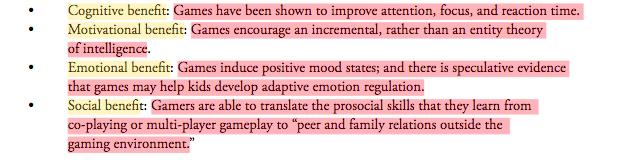
Shapiro also brings up a survey research by Killian Forde and Catherine Kenny about how kids who play online multiplayer video games are 62% more likely to be more friendly and positive attitude towards people from another country. (P.7). He also includes a study published by Nature on how violent/action video games improve “attentional processing”, and “induces long-lasting improvements in contrast sensitivity, a basic visual function that commonly deteriorates with age” (P. 7)
I discovered another article by Shapiro titled, “Can Games Make High Stakes Tests Obsolete“. The article is about how teachers could use game based assessments and game data play would give them data on whether their students are understanding the material. If the students are not understanding the material then it will bring awareness to the teacher about there teaching style and how they can make changes to there teaching style so the students will be able to understand the material more clearly.
Another article I came across by Shapiro was “Social Emotional Benefits of Video Games: Metacognition and Relationships“. In this short reading, Shapiro discusses the benefits of how games develop social emotional skill with children by collaborating with one another by giving personal tips, insights, and opinions on the game.
LOST AND FOUND – McCALL
Jeremiah McCall is a teacher and a historian and in his podcast on his game, “Lost and Found“, he discusses how it is played and how history ties into the game to benefit students. McCall’s game is a historical strategy game where the player takes on the role of being in charge of a family, having the choice to collaborate with their neighbors while trying to avoid disasters and making the right choices that will benefit their family and the community. The game takes place during the medieval times in Africa. This game can benefit students not only by showing them but by letting them understand what it was like for people at the time and to make choices that could ultimately lead to survival or fate.
McCall provides on his website Gaming of the Past a list of different history games that could be played on the computer. Some of the games are free and just require adobe flash and other games need to be purchased in order to play them. There are multiple games on there that range from different time periods like the Underground Railroad, Civil War, Vietnam War, Industrial Revolution. One game takes you to a website called MissionUs. The motive for this game is for students to
- Learn how Americans struggled to realize the ideals of liberty and equality.
- Understand the role of ordinary men and women, including young people, in history
- Develop historical empathy
- Build understanding and critical perception to think like an historian
This source will be very useful for me for later in my education career because these would be great games for me to use for my classroom so that students will get a better understanding of what it was like at the time instead of just listening to a lecture about it.
KAHOOT
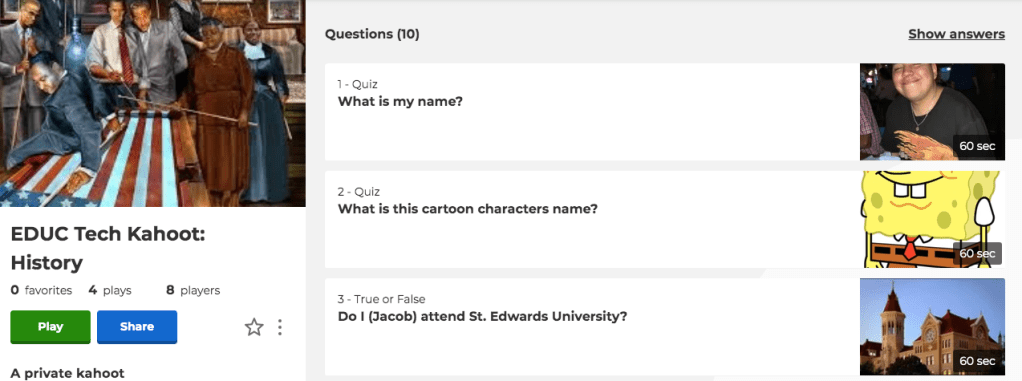
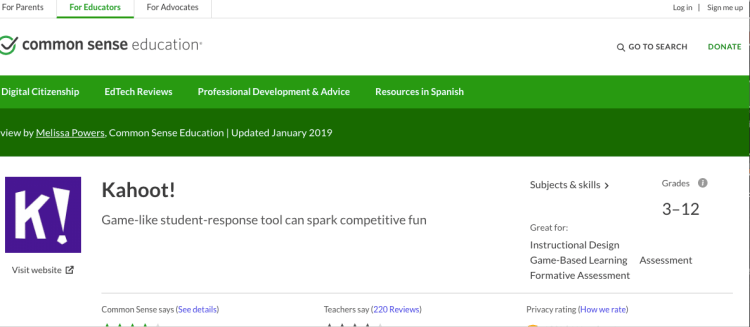
I chose to use the online tool Kahoot which is an online game that uses multiple choice or true or false based questions. In order to play students could either download the app or use any browser and it could be played individual where students are responsible for their own answers or they could play cooperatively in teams and share their opinions on the answers. Once the teacher choses how they want their students to play, a code is becomes displayed on the screen and student will enter that code on the browser or app and they will then be able to create their own username for the game. The game is based off points so the student(s) who answer correctly and faster get the most points. The player(s) with the most points at the ends wins.
I conducted my kahoot trial in person with some of my family and I selected that they play individually. Before starting I told them that I am the teacher and they are my classroom. I asked the class if anyone has ever played the game and only one student rose there hand and I told the class how the game is played, but I told them that the competition of whoever gets the most points is between the students and that I am looking for who is getting the questions right and wrong. If few students get them wrong I will let them know individually that if they need clarification to come see me in my office hours. If a majority of the class gets a question wrong then we will pause the game and go over the material together because It was my fault as a teacher that they got the question wrong and I either confused them, did not clarify the material enough for them to understand or it was just a terrible question. I started the game with 3 sample questions for the students who had never played before so they can know how to answer the questions.
POSITIVE/NEGATIVES OF KAHOOT PLAY

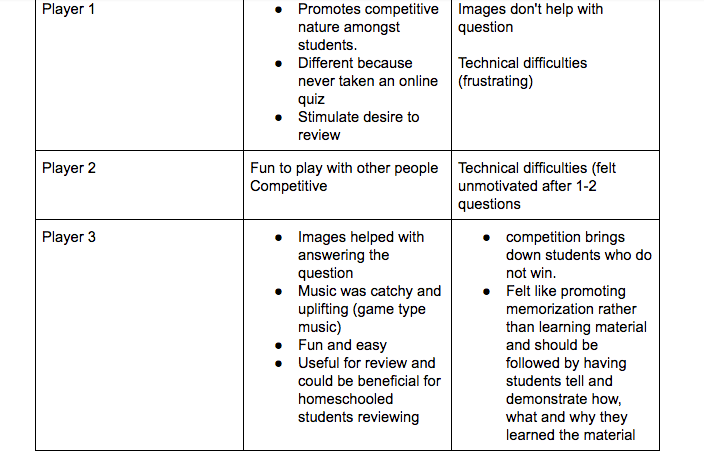
At the end I asked my family the positive and negatives of the games. The negatives were all similar. Technical difficulties with the questions loading up while the question timer was ticking down, I was suspecting that it was because there were to many on the wifi all at once which was causing the delay and it was causing frustration which made the students felt like they did not want to play anymore. Another negative that was brought up by player 3 was that competitiveness might bring the students self-esteem down if that student is consistently getting the questions wrong while their classmates are getting the questions correct. Additionally player 3 brought up that kahoot might promote students to memorize rather than to understand the material. The positives were that it was a fun game and it was enjoyable and that it was a good tool to use for review before taking a test.
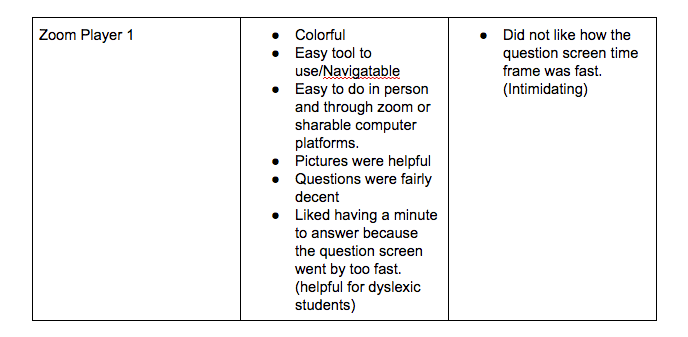
I also played a Kahoot game with a friend over Zoom because with COVID-19 affecting school all over the world, I wanted to see if this could actually work over the computer. In order for the game to work I needed to share my screen because the questions are only displayed through my screen. Once I shared the screen Zoom player 1 was able to answer the questions. There negative was only that the question screen did not give them enough time to read the question before having to answer the question although the question is displayed again with the answer choices. They did like that they had a full minute to answer the question and that it might be helpful for students who have dyslexia or trouble reading fast. The questions were not hard because the pictures were helpful with answering.
This game would be used as a review right before a test for a refresher of the material that will be on the test and as a tool to let students know what material they need to review a little more on.
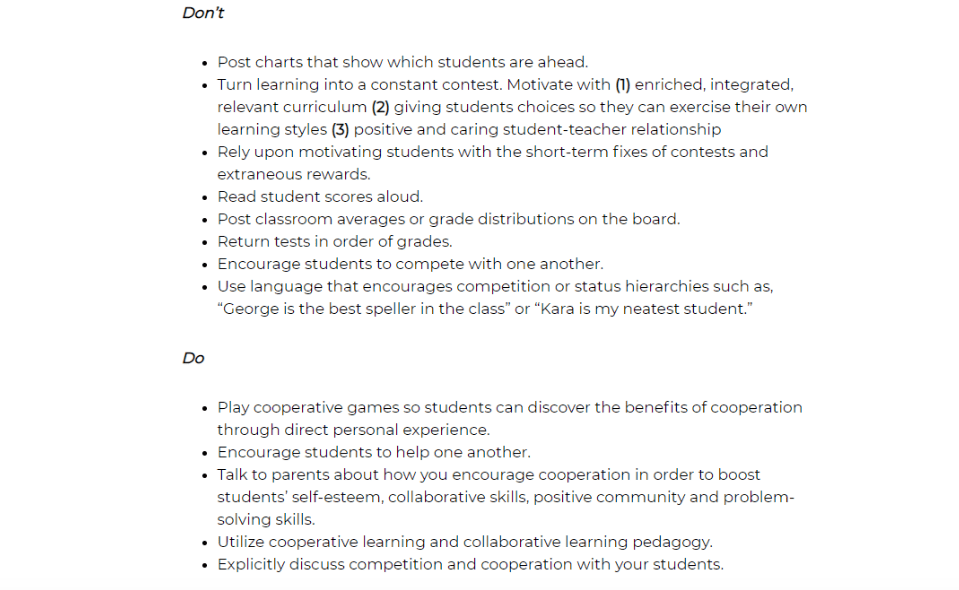
Although I did get a majority of good reviews for the Kahoot game, I did discover an article that criticizes the game Kahoot and that teachers should stop using. The article, “It’s time to stop using kahoot as a whole class review tool“, was written by Chris McNutt. McNutt criticizes Kahoot saying that the online tool is a “trivia machine” and relies heavily on memorization and of whoever answers quickly and correct gets highest score. He also argues that it also causes issues with students who have trouble reading fast and that making students compete against one another causes those students who struggle to feel pressured and that teachers should make the students work cooperatively to help one another. McNutt also includes some bullet points of Do’s and Dont’s for teachers in the classroom.
Along with using Kahoot, I would want to also want to use other platforms of games such as board games like Stratego and a hands on game that does not require technology and that I learned from mentor called Trashball.
STRATEGO – BOARD GAME

I wanted to use the board game Stratego because I believe it would give students the experience of how military leaders had to strategize on winning battles. I would implement this game specifically when learning about the Civil War because it would imitate battle scenes like the Battle of Gettysburg, first and second Battle of Bullrun , or the Battle of Antietam with the red resembling the South and the Confederate Army and the Blue representing the North and Union Army. Students will learn about how generals have to make the right choices in order to lead there side to victory.
TRASHBALL

In the final game I wanted to use was a game I played and learned from my former high school English 1 teacher and mentor Ms. Z called Trashball. Ms. Z uses this game before her classes have a test. The motive of the game is to refresh the students mind about the stories characters, the characters actions, the stories setting, motives, and plot of those stories. The game set up is that the classroom trash can is the goal, the ball which is a big wad of loose leaf paper crumbled up, and the points of the game are labled with tape on the floor with the lowest point being the closest to the trash can and the highest point being the furthest from the trash can. The points are 1 (3-4 feet away from trash), 2 (5-6 feet away from trash), 5 (8-10 feet away), and 10 (furthest from trash). The class is then split into two groups.
To decide who would go first Ms. Z would have 1 member from each side play rock, paper, scissors to see who would go first. Ms. Z would then call out one team member at random of that winning group to answer the question for their team. Ms. Z uses flash cards with the questions on the front and the answers on the back of them about one of the stories they read as a class. The student who is asked the question could get help from members of their team to answer the question. If answered correctly the student that was called and answered for their team get a chance to shoot the paper ball into the trash at which ever point they choose to shoot from. They could have another member of their team answer for them and shoot for them if they choose too if they are too shy. And the same process would be for the next team. If the question is answered wrong then the opposing team has the chance to steal and have 30 seconds to gather up in a group and work together to respond with the right answer. If the opposing team answers correctly they have the chance to shoot the paper ball. If both teams answer wrong the question would be put back in the deck and come back to later. If the team that answers the question correctly and misses the shot no points will rewarded.
These 3 games would be super beneficial for teaching your children in our history classroom because I believe they will help develop a better understanding of what we are learning in the classroom, why we are learning. I would use Kahoot for a fun online review game where students are able to their electronics. Stratego because it is a history lesson that does not involve pencils, paper, or powerpoint. It involves students to get that face to face learning and develop social emotional skills. Trashball would be used as a competitive cooperative game to use just before taking a test that does not involve technology and especially if the technology fails there would be the option for trashball as a back up if kahoot fails for the lesson.















 History in the Making